
Rigorous Methods for Public Health.
January G. Msemakweli uses statistical reasoning, programming, and computational tools to design, analyze, and interpret complex health data.

Beyond Analysis
My work centers on improving evidence generation and decision-making in real-world public health settings. My primary professional identity is methodological rather than disease-specific.
I build applied data systems and digital tools—platforms, dashboards, and geospatial workflows—that translate raw data into actionable insights.
- Causal Inference Methodology
- Statistical Modeling Reasoning
- Reproducible Pipelines Science
- Study Design Architecture
- Digital Public Health Systems
Core Methodological Expertise
Developing interpretable and scalable analytical frameworks that bridge methodological rigor with practical impact.
Quantitative Methods
Specializing in study design, causal inference, and advanced statistical modeling to address complex health questions.
Data Science
Building reproducible analytical pipelines using modern computational tools (R, Python) for public health practice.
Applied Systems
Designing and implementing digital tools, dashboards, and geospatial workflows for real-time health intelligence.
Selected Analytical Tools & Research
Showcase of R/Shiny applications and published methodological research at the intersection of data science and public health.

Two-Sample MR
A R/Shiny Web App for Two Sample Mendelian Randomization. Perfect for analyzing genetic causal inference using GWAS summary statistics.
- • Upload Exposure & Outcome Data
- • Map columns manually
- • Run complex analysis
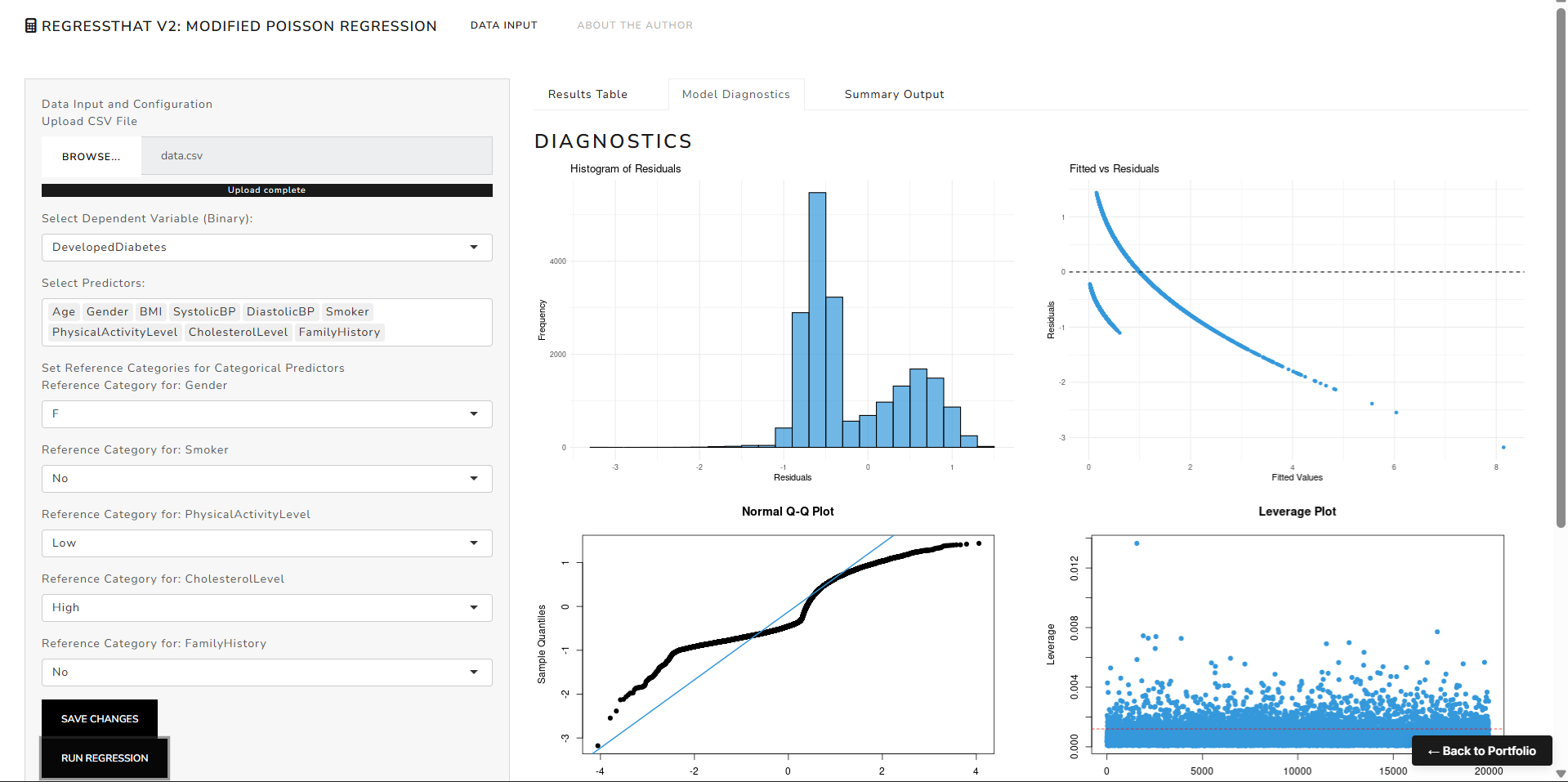
RegressThat v2
A R/Shiny Web App for Modified Poisson Regression with Robust estimator. Perfect for analyzing binary outcomes in epidemiological studies.
- • Upload CSV files & configuration
- • Run regression with robust estimators
- • Download results as Excel

Between-hospital variation in liberation from invasive mechanical ventilation
Benchmarking ventilation duration without treating death as a competing event misses the units that are failing to liberate patients, and those units have higher mortality.
Journal of Critical Care · Vol. 97 · 155743 · 2027 · DOI: 10.1016/j.jcrc.2026.155743
Read article →